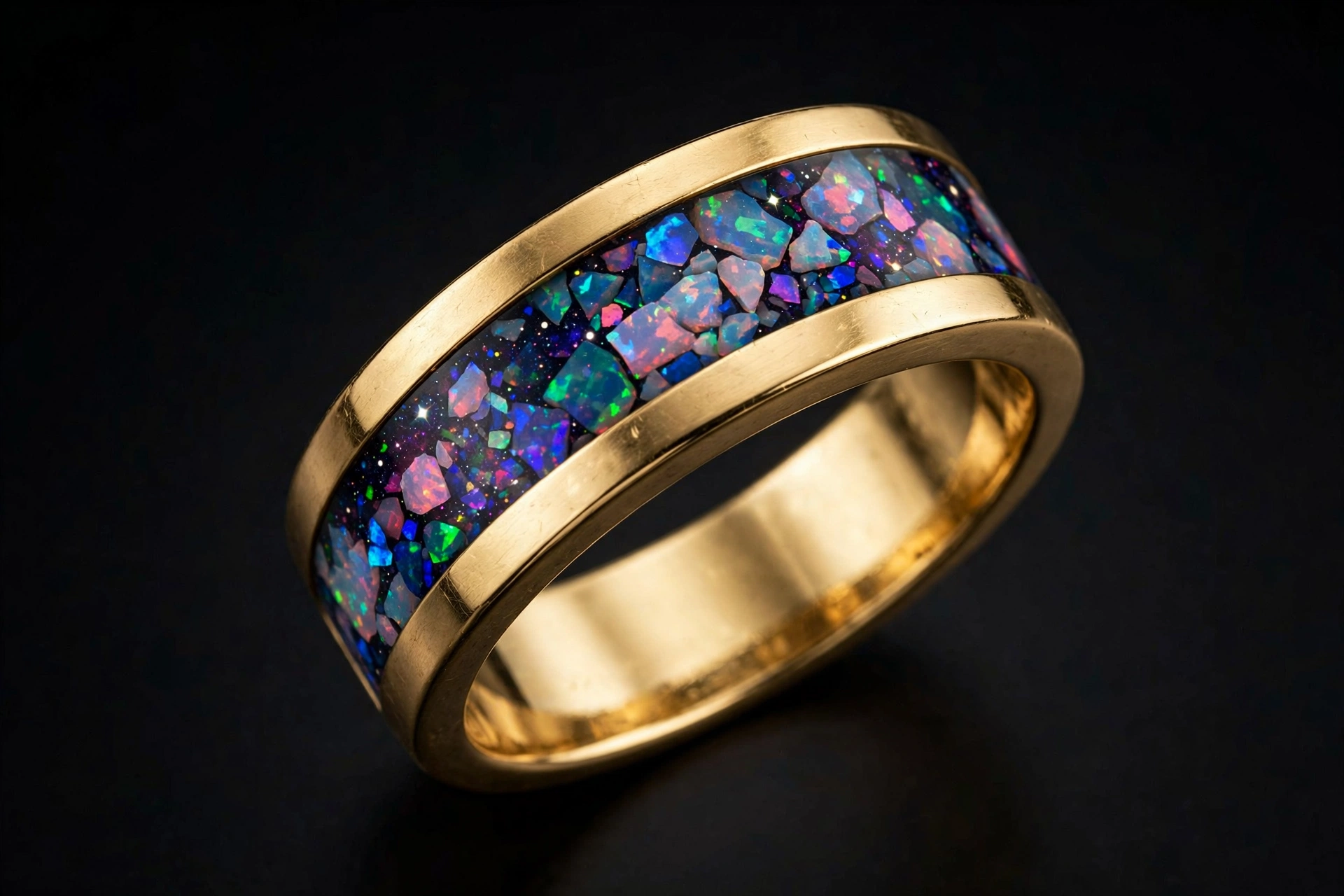
The idea
Crush the stone, pack it into the channel in thin glued layers, sand it flush.
A channel ring blank (tungsten, titanium, silver — the groove does the work) gets filled with a mix of stone chips and powder held in cyanoacrylate or epoxy. Built up in layers and sanded flat, it polishes into a solid band of stone. Black tourmaline in a gold-tone channel is the classic high-contrast combo; emerald, lapis, and opal all work the same way.
This is glued inlay, not mechanical setting — the adhesive is the technique. Done right it's permanent; done in one deep pour it's rubbery and pops out.
What you need
- Channel ring blank — sized to your finger. Tungsten carbide blanks are cheap and brutally hard (they'll outlast the inlay); make sure the channel is clean and dry.
- Stone — any rough, offcuts, or tumbled chips. You need only a small piece; a 3 mm channel on a size-10 band takes a few grams.
- Thin CA glue or 2-part epoxy — thin CA builds fast; epoxy gives the strongest fill but demands full cure time (usually 24 hours).
- Sandpaper 220 through 2000+ grit, used wet, plus polishing compound and metal polish.
- Dust mask and eye protection — stone dust is not a breathing project.
Stone prep
- Crush in a bag — hammer or wrapped pliers, controlled taps. You want a mix: small chips (~1–2 mm) plus fines to fill between them. Pure powder looks flat; chips give the inlay depth.
- Rinse off the dust and let it dry fully. Dust-only layers cure weak.
Channel prep
- Scuff the groove lightly — needle file or coarse paper. Glue needs tooth, not polish.
- Degrease with alcohol or acetone and let it evaporate. Oils kill the bond.
Build the inlay
- Thin layer of glue in the channel — no deep single pours, especially with epoxy.
- Sprinkle stone over the glue and press it lightly into place with a fingertip or flat tool.
- Repeat — glue, stone, press — until the channel is packed slightly proud of the surface. Proud on purpose; you'll sand it down.
- Cure fully. CA sets fast (accelerator optional); epoxy needs its full cure time. Rushing the cure is how inlays loosen.
Finish
- Sand flush: start ~220–400 grit, work up to 1000+, wet. Sand stone and band together — keep pressure even and the block flat so you don't gouge the channel walls.
- Polish: 2000+ grit, then polishing compound on the stone and metal polish on the band. Most inlay stones (tourmaline is 7–7.5) take a bright, glassy polish.
Trouble signs
Inlay crumbles when sanding — a layer didn't cure fully, or too much powder and not enough glue and chips. Rebuild that section.
Epoxy looks gummy or soft — poured too deep in one go. Scrape it out and rebuild in thin layers.
Gaps at the channel walls — stone wasn't packed against the edges. Fill voids with glue and fines, then re-sand.
Band gets scratched while sanding — back down a grit, keep the block flat, and finish with fine grits and metal polish.
Inlay is a glue technique — the bond is everything. Thin layers, full cure, and a degreased channel are what separate a permanent inlay from one that pops out in a month.