Yttrium aluminum garnet — Y₃Al₅O₁₂. A synthetic garnet with a laser pedigree and a quiet second life at the faceting bench.
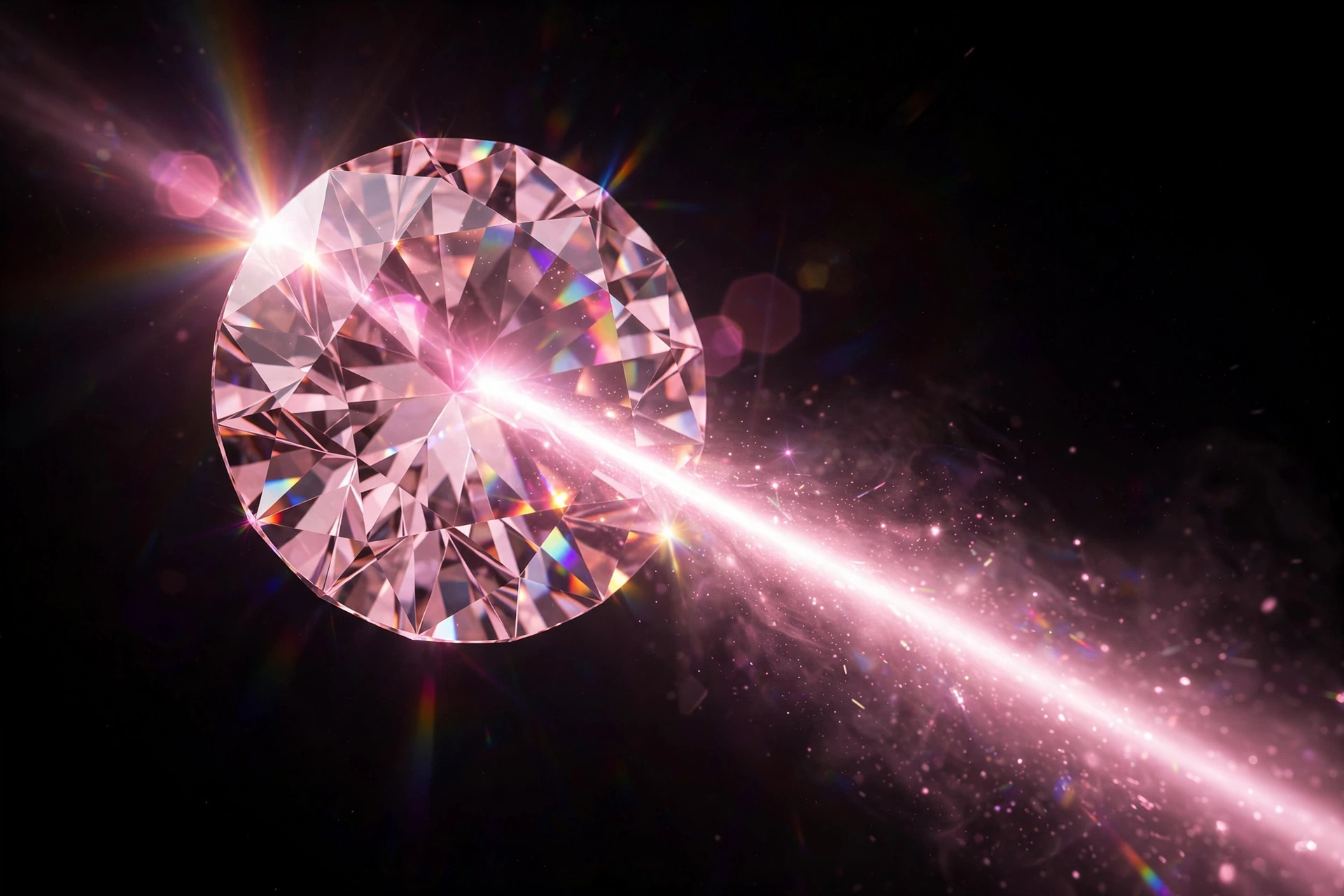
YAG is a man-made garnet. Its chemistry is yttrium aluminum garnet — Y₃Al₅O₁₂ — crystallizing in the cubic garnet structure, the same family as natural pyrope, almandine, and demantoid. Nobody digs it out of the ground; every piece starts in a crystal-growth furnace, pulled from a melt by the Czochralski method into long cylindrical boules, then sawn into faceting rough.
It was never invented to be a gemstone. YAG was developed in the early 1960s at Bell Labs as a host crystal for solid-state lasers. Doped with neodymium, it became Nd:YAG — the workhorse laser crystal of the next half-century, used in everything from industrial cutting to medical instruments. The gemstone use came later, almost as a side effect: here was a hard, clear, beautifully polishable synthetic crystal being grown by the ton, and faceters noticed.
| Property | YAG (undoped) |
|---|---|
| Refractive index | 1.83 |
| Dispersion | 0.028 |
| Hardness (Mohs) | 8 – 8.5 |
| Specific gravity | 4.55 |
| Critical angle | ~33.1° |
| Cleavage | None |
| Toughness | Excellent |
The 1.83 refractive index puts YAG in a sweet spot for faceters: high enough for strong brilliance and real fire (dispersion 0.028 beats quartz at 0.013 and glass at ~0.010), but not so high that standard brilliant designs need re-engineering. Pavilion mains around 41° sit a comfortable ~8° above the critical angle — generous margin, forgiving of small angle errors on a less-than-perfect machine.
Pure YAG is colorless. The colors come from dopant ions added during growth — the same doping that makes it a laser crystal:
| Dopant | Color produced | Notes |
|---|---|---|
| None (undoped) | Colorless / white | The classic "white YAG" |
| Neodymium (Nd) | Pink to lavender | The laser dopant; Nd:YAG is the famous one |
| Neodymium + Cerium (Nd:Ce) | Light pink | Common faceting rough |
| Chromium (Cr) | Red to pink-red | Deeper reds than Nd |
| Erbium (Er) | Rose pink | Softer pink tones |
| Cerium (Ce) | Yellow to greenish-yellow | Less common as rough |
| Holmium / Thulium | Various greens and blues | Specialty colors |
Because the color is built into the crystal lattice rather than painted on, it can't fade, rub off, or change with heat the way some coatings and treatments can.
YAG is one of the friendlier synthetics at the bench:
YAG is often mentioned alongside the other colorless synthetics. Here's the plain data:
| YAG | CZ | Lab diamond | Glass | |
|---|---|---|---|---|
| Composition | Y₃Al₅O₁₂ | ZrO₂ | C | SiO₂ mix |
| Refractive index | 1.83 | 2.15–2.18 | 2.42 | ~1.52 |
| Dispersion | 0.028 | 0.058–0.066 | 0.044 | ~0.010 |
| Hardness | 8–8.5 | 8–8.5 | 10 | 5–6 |
| Specific gravity | 4.55 | 5.6–6.0 | 3.52 | ~2.5 |
YAG was actually the earlier diamond simulant — it hit the jewelry market in the late 1960s, before cubic zirconia arrived in the late 1970s and took over on price. CZ is cheaper to manufacture in bulk, which is why it dominates the simulant market today. YAG never left, though; it just settled into its niches — laser crystals first, faceting rough second.