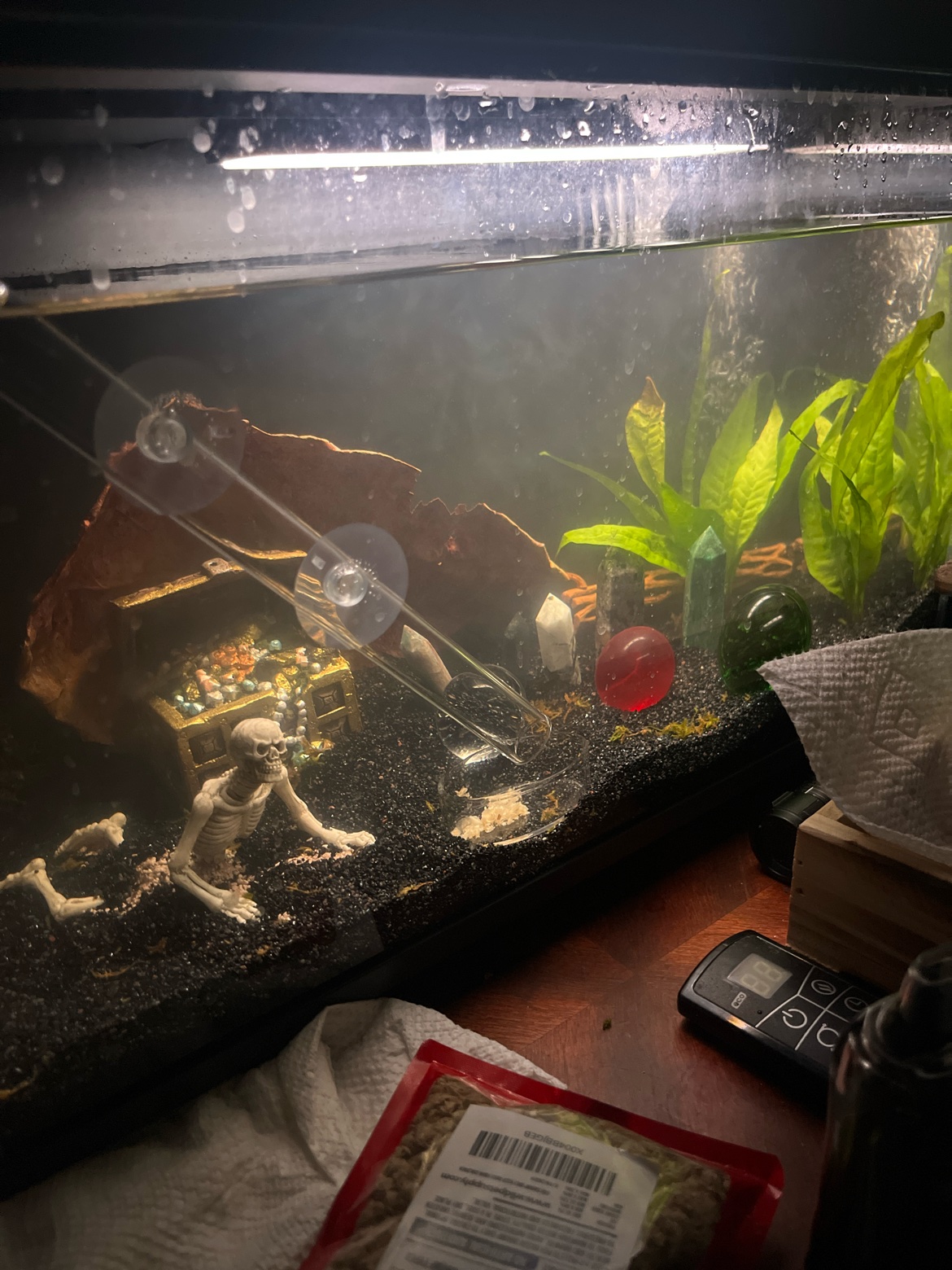
How a gemstone bench acquired fifty red shrimp, three extra tanks, and a breeding program. Told from the beginning — new chapters go underneath as it happens.

Gem Beam is a faceting bench — original gem cuts, cut by hand. The shrimp started as a sideline and then, the way sidelines do, organized themselves into a project. The honest summary is the one from the bench: making aquarium gems is the reason for it all. The cutting serves the tanks. This page is the tanks' side of the story.
There was a betta first — a pink-red halfmoon in a tall two-gallon tank in the living room, a fish with a personality large enough to reorganize a household. His tank got the first faceted glass pieces: smooth stones, crystal points, gems cut at the bench and dropped in as treasure. That was the whole idea at the time. A fish, a tank, some treasure.
Then came the question every fishkeeper eventually asks: what else could live in water around here?
The answer was Neocaridina — cherry shrimp, in the deep-red line called Bloody Mary. Fifty founders were ordered from Shrimply Fintastic in San Francisco, and then, deliberately, not shipped. The order went on hold with the seller until the water was ready. That is the first rule of this project, learned before a single shrimp arrived: the livestock waits for the water, not the other way around.
Fifty shrimp need somewhere to land. So before any shrimp, there had to be a tank — charged, tested, and proven.
The receiving tank is a five-gallon smart kit in the bedroom. It was set up on Halloween and its charge started the same day, fed on water changes from the betta's tank — a working colony's water and waste, put to work growing a new one.
Decor went through the project's second rule: everything unknown gets soak-tested before it touches a tank. A resin shipwreck failed within a day — slimy, smelling of paint — and never went in. A skeleton and a treasure chest passed and took their places, posed together like a pirate crew that lost its ship. Crystal points, glass balls, and a catappa leaf completed the scene. An old lesson stands behind the rule: a bad decoration once nearly killed a fish in this house. The soak test is cheap. Funerals are not.
Then the project got an education in water. The local tap water is liquid rock — a general hardness of 20 degrees, against a shrimp target of 6 to 8. The house filter (a Berkey) makes water safe — it strips chlorine and chloramine — but it leaves every mineral exactly where it found it. Safety and softness turned out to be two different jobs, done by two different tools.
Softening is reverse-osmosis water's job. Gallon by gallon, RO swaps walked the five-gallon down from GH 20 to GH 9. Along the way came the project's most useful piece of chemistry: the bacteria live on surfaces, not in the water. A water change cannot pour a colony down the drain, because the colony was never floating in the first place. It lives in the filter, on the wood, in the substrate. Water is just the weather it lives in.
Five gallons is a start, not a home. On November 3 a fifteen-gallon low-iron glass cube was ordered — the colony's eventual home — and by November 9 it stood filled in the bedroom: a bed of black Flourite, a single large piece of dragon wood as the centerpiece, cholla logs at its base, red root floaters corralled on the surface.
The cube's water went tea-colored with tannins from the wood, which is not a flaw here — tannin water is the house preference. Then the water turned smoky: a bacterial bloom, the visible sign of a charge booting up. You do not fix a bloom with water changes. You let it clear itself, because the cloud is the colony arriving.
The cube got one more head start. Of all the cholla logs in the house, exactly one had grown a silky coat of biofilm in its two-gallon tank. That log — the ghost log — was moved wet into the cube, carrying its mature surface with it, to seed everything it touched. Meanwhile, on the bookshelf, two two-gallon tanks were quietly charging their own colonies on doses of pellets, for jobs they would be given later.
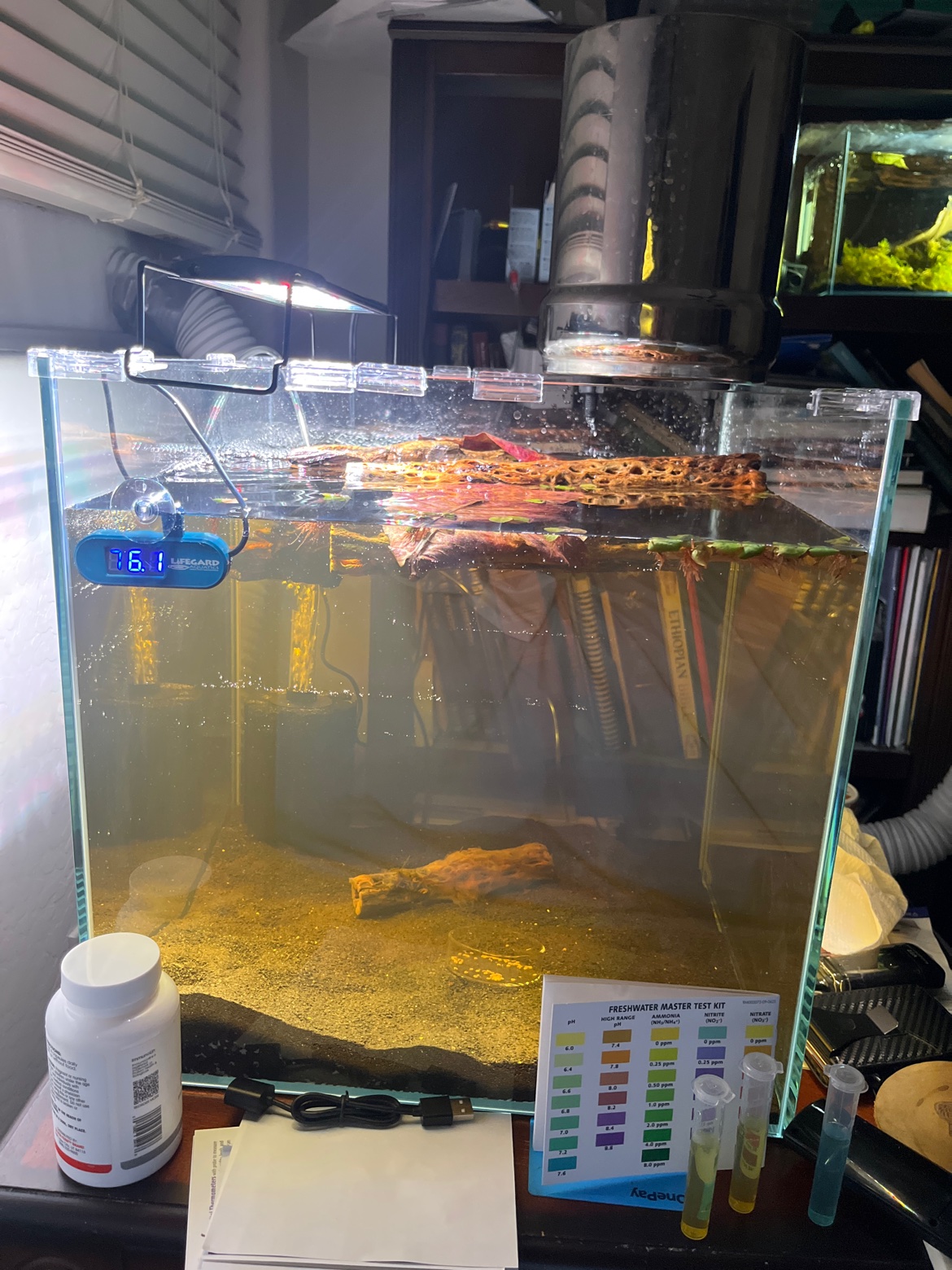
On November 11 the five-gallon's full panel came back: ammonia zero, nitrite zero, nitrate present, GH 9, KH 2. In the project's language: charged. The receiving tank was ready for its founders, eleven days before they were due.
The last piece of hardware was a patch of filter foam over the intake — 35 PPI, fine enough that baby shrimp, when there are babies, cannot be drawn in. The tank was ready for shrimp that do not exist yet, including the smallest ones. That is the correct order of things.
With the water ready, the project stopped being about keeping shrimp and started being about breeding them. The layout settled: the colony starts together in the five-gallon; at the first sort, a few months in, the chosen males move to a two-gallon bachelor tank and visit; the colony itself graduates to the cube. Culls go down a ladder — the best surplus to a local store, the odd ones to other hobbyists, and only the true bottom to a cull tote, which will be tested with culls before anything valuable trusts it.
And then there is the next breed. The Orange Eye Black Demon is a Neocaridina line with two traits: a black body, and eyes the color of a traffic light's amber. The genetics were worked through carefully. Cross a Demon with a Bloody Mary and the first generation is a letdown by design — mottled browns and chocolates, every one of them dark-eyed, because the orange eye is recessive and hides. The Demons appear in the second generation, and the prize — a red body wearing orange eyes, a Red Demon — exists nowhere until a breeder selects for it, generation by generation.
The campus for that work got its names, and the names are staying: the pure tank, where the Demon line is kept clean; the bastard tank, where the cross is made and the carriers live; and the breed again tank, where the second generation reveals who is carrying fire in their eyes. One Demon female will live loose among the reds as the bridge. Everything else stays pure.
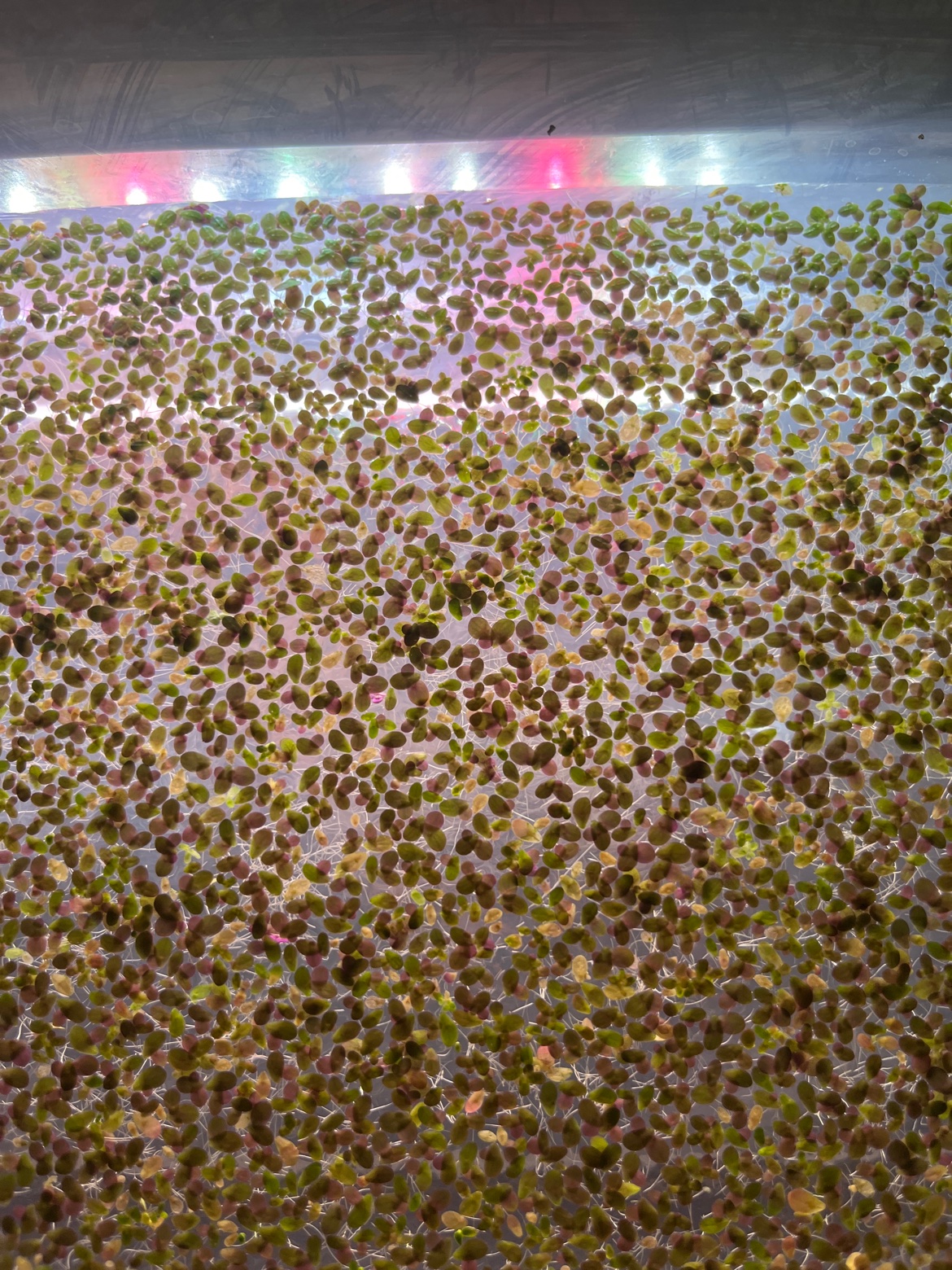
The same week, a quarantined tub of duckweed — bought as plants, rejected as a pest risk, never allowed near a tank — was sentenced to a useful death: blanched, it becomes shrimp food, and nothing living from that tub ever crosses over. Even the mistakes here get audited for parts.
The last piece of water education arrived this week: stop blending and start building. Shrimp water is now made from pure reverse-osmosis water plus a measured remineralizer — SaltyShrimp Shrimp Mineral — dosed to a recipe: GH 7 to 8, KH about 3.5 to 4, TDS in the low two-hundreds. Not the softest water, not the hardest: the center of the band, with margin in both directions, because molting shrimp collect their bills at the extremes. A TDS pen is on its way to check the numbers, because a target you cannot measure is just an opinion.
The duckweed, meanwhile, got promoted from sentence to product development. Dried to powder, bound, and pressed through a homemade die plate, it becomes shelf-stable pellets that fit the automatic feeders — working name, Gem Beam Duckweed. And the Demon program got its name the same day: the generations bred here will be Gem Beam Demons. What is bought is seed stock. What is made carries the brand.
The cube's future was also sketched: a green algae carpet grown deliberately over the wood and rock — pasture and scenery in one — with a few Amano shrimp added later as the mowing crew, the one shrimp that can work in a breeding tank without ever touching the bloodlines. One nerite snail is permitted in the cube, for the hard algae spots on the glass. The other tanks remain, by rule, snail-free.
That is the story to date, and it ends, properly, at a doorstep. The call has gone to Shrimply Fintastic: ship Tuesday. On Wednesday, November 18, fifty Bloody Mary shrimp arrive at a charged tank, in tested water, under a foam guard built for their grandchildren.
The same Wednesday, a second delivery lands: a new faceting machine, an Ultra Tec VL, months of bench frustration answered. It has been told, in writing, that it has to get in line. Shrimp first. The cutting serves the tanks.
The next chapter goes underneath this one when there is something to tell. It starts with a bag of red shrimp, floating in a five-gallon tank, in a warm bedroom, on a Wednesday.