How to identify, grade, and put an honest number on a laboratory-grown or synthetic faceted stone — at the bench, for insurance, and for sale.
Who this is for. A faceter pricing his own finished synthetics, a seller writing a listing that will hold up, and anyone handed a synthetic stone and asked, “what is it worth?” It follows the framework working appraisers use today: published market charts, current comparables, and production cost — stated separately for each purpose the number will serve.
What this is not. This is a working guide, not a certified appraisal. A formal appraisal for insurance, estate, tax, or litigation must be performed and signed by a qualified, independent appraiser for that specific assignment, with the stone examined in hand. Use this guide to price, to document, and to know when a formal appraisal is worth paying for.
Most bad numbers on synthetic stones come from answering the wrong question. The same stone legitimately carries three different values, and an honest appraisal names which one it is reporting, for whom, and as of what date.
Three categories get blurred in listings, and the blur is where money and trust are lost. Only the first shares chemistry with its natural counterpart.
| Term | What it is | Appraisal consequence |
|---|---|---|
| Synthetic / laboratory-grown / laboratory-created | Same chemical composition, crystal structure, and optical and physical properties as the natural stone, made by people. Synthetic corundum is corundum; synthetic spinel is spinel. | Appraise as that species, synthetic origin. Growth method (flame-fusion, pulled, flux, hydrothermal) affects cost and is part of the description. |
| Simulant / imitation | Looks like another stone but is a different material: cubic zirconia simulating diamond, YAG or glass simulating something else. | Appraise as what it is, never as what it imitates. A blue glass-ceramic “nano” stone is glass-ceramic — it must never be described or valued as sapphire. |
| Assembled / coated / treated | Doublets, triplets, coated stones, diffusion-treated material. | Disclose the construction or treatment; value drops sharply and durability notes belong in the report. |
In the United States, it is unfair or deceptive to use the name of a precious or semi-precious stone for a product that is not a mined stone of that type unless the name is immediately preceded, with equal conspicuousness, by “laboratory-grown,” “laboratory-created,” “[manufacturer]-created,” or by “imitation” or “simulated” for a simulant (§23.25). “Faux” alone is not an adequate disclosure. In practice: write “laboratory-grown sapphire,” never just “sapphire,” in every title, tag, invoice, and appraisal — not buried in fine print or a hashtag.
Synthetics are no longer appraised by rule of thumb. The trade has published pricing: The GemGuide, published by Gemworld International, has carried price charts for lab-grown diamonds since 2019 and for lab-grown colored stones alongside its natural-stone charts. Working appraisers start there, then apply the same standard framework used for any gemstone — with two synthetic-specific adjustments: no rarity premium, and a value that expires.
Lab-grown prices fall as production scales, and they have fallen fast. GemGuide’s own history makes the point: a 1.00-carat lab-grown diamond (round, D–F, VS) wholesaled at $2,650–$3,750 per carat — about $3,175 on average — when the charts began in late 2019. By the March/April 2026 issue it was $180 per carat. That is a decline of roughly 94% in about six years, driven by production cost falling toward the cost of growing and cutting, not by any change in the stones themselves.
| Benchmark: 1 ct lab-grown diamond, wholesale | Price per carat |
|---|---|
| Late 2019 (GemGuide charts begin) | $2,650–$3,750 (avg. about $3,175) |
| November 2025 GemGuide update | $250 |
| March/April 2026 GemGuide update | $180 |
Colored synthetics have fallen more gently — they were never priced as high — but the direction and the lesson are the same. An appraisal of a synthetic is a snapshot, not a permanent figure. Date every value, state the chart or comparables it rests on, and re-check before relying on it for insurance renewal, a sale, or a buy decision. A replacement value written five years ago will almost certainly overstate what replacement costs today — which means the owner may be paying premiums on value that no longer exists.
For synthetics, growth method often moves cost more than the species name. Flame-fusion (Verneuil) is produced in hours and is cheapest; pulled (Czochralski) costs more; flux and hydrothermal take weeks to months and sit at the top of the range. Finished ranges below are indicative ballparks for well-cut loose stones around 1 carat from current market listings — verify against current comparables before quoting one, because synthetic prices move. For rough, the companion reference is the Gem Beam Market Board (gembeam.design/market.html), surveyed weekly, one price per row at its high — see page 7 for its lab-grown emerald row used as a worked material cost. This guide covers synthetic stones only, so only the board’s synthetic rows are used here.
| Material | RI / Mohs | Typical growth | Value behavior |
|---|---|---|---|
| Lab-grown diamond | 2.42 / 10 | CVD, HPHT | Charted in GemGuide since 2019; steepest price falls in the trade (page 4). Resale is a small fraction of retail. |
| Synthetic corundum (lab-grown ruby & sapphire) | 1.76–1.77 / 9 | Flame-fusion, pulled, hydrothermal, flux | Finished stones roughly $20–$200/ct at retail depending on method and quality; flame-fusion rough costs a few dollars per carat to produce, flux far more. |
| Synthetic emerald | 1.57–1.58 / 7.5–8 | Hydrothermal, flux | Priciest common colored synthetic: roughly $50–$400/ct commercial to good, premium hydrothermal higher. Color drives about half the value. |
| Synthetic spinel | 1.73 / 8 | Flame-fusion, pulled | Rough is inexpensive in bulk, so a finished stone’s price is almost entirely cutting. Cobalt-blue sells on color, not material cost. |
| YAG (incl. Nd:Ce pink, Cr pink) | 1.83 / 8.5 | Pulled (laser-crystal stock) | No natural counterpart in jewelry use — price it as its own material: rough plus cutting. Color and size carry it; there is no natural comparison to discount from. |
| Cubic zirconia | 2.15–2.18 / 8–8.5 | Skull-melt | Material value near zero at any size; a CZ price is cutting and setting only. |
| Moissanite (silicon carbide) | 2.65–2.69 / 9.25 | CVD / sublimation | Always lab-made. Roughly $150–$450 for a 1 ct finished stone at retail; priced by size and cut brand more than weight. |
| Synthetic quartz | 1.54–1.55 / 7 | Hydrothermal | Optically identical to natural quartz, itself inexpensive — value is cutting and novelty colors. |
| Glass & glass-ceramic (“nano”) | varies / 5.5–7 | Melted / sintered | Simulant class. Describe and value it as glass or glass-ceramic, never under a gem species name. |
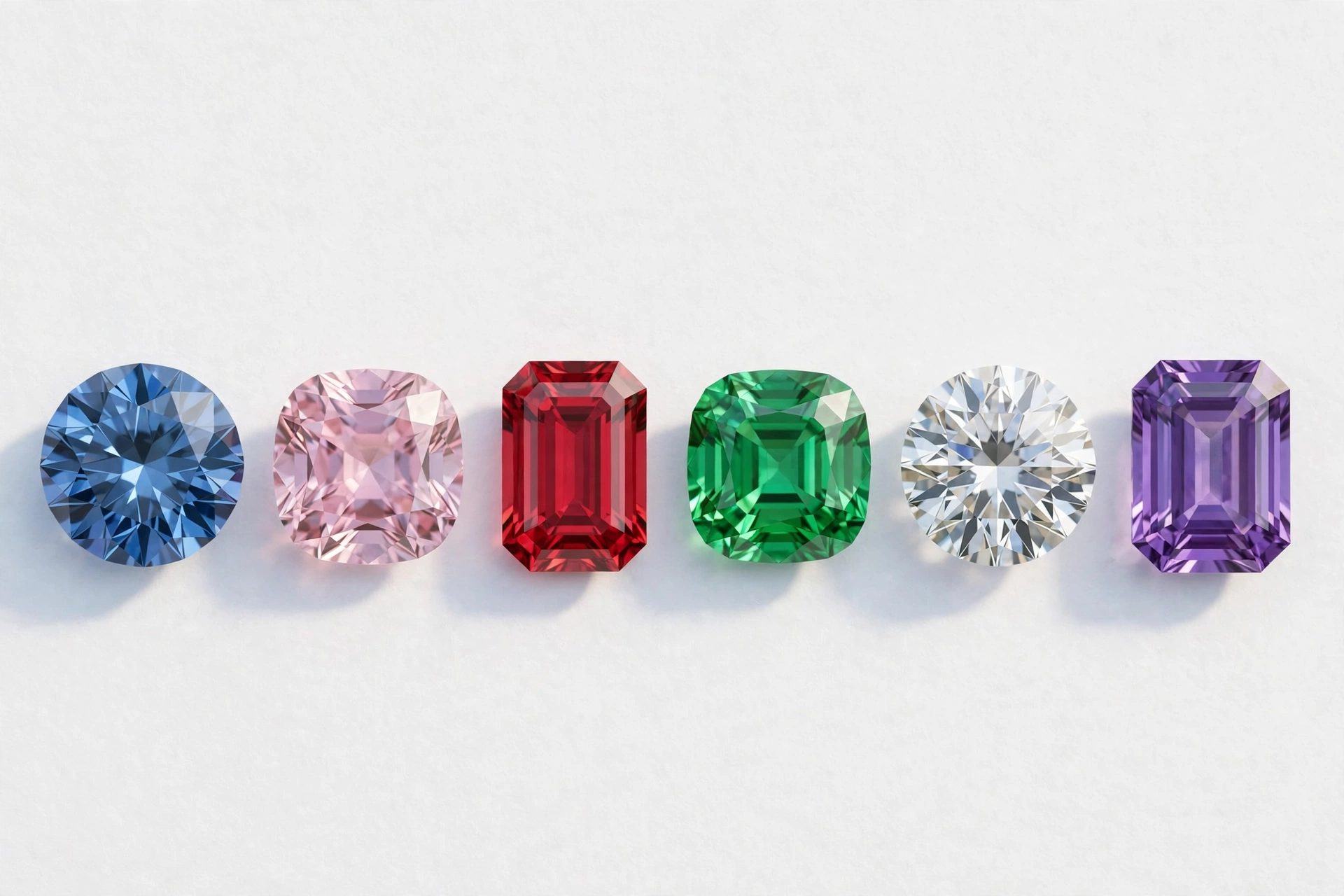
Two stones cut from the same boule, at the same finished weight, can differ in price by a factor of three or more. The difference is the cut: buyers are paying for how well this stone was planned, met, and polished. Grade the cut before you price the stone, using the same 100-point rubric every time so your numbers stay comparable.
| Factor | Points | What earns the points |
|---|---|---|
| Light return | 30 | No window through the table at normal viewing angles; no dead, dark zones; brightness across the whole face, not just the center. Pavilion angles sit safely above the material’s critical angle — arcsin(1 ÷ RI) — with margin. |
| Meets | 25 | Facet junctions meet point-to-point at 10x. Overcuts, undercuts, and wandering girdle lines deduct fastest here. |
| Polish | 20 | Mirror facets with no scratches, pits, or frost visible at 10x; sharp facet edges; table free of polish lines. |
| Symmetry & proportion | 15 | Outline true to the design; girdle even; culet (or keel) centered; crown and pavilion in the proportions the design calls for, adjusted correctly for the material’s RI. |
| Color as cut | 10 | Color even across the face; orientation shows the best color; saturation suited to size — dark material cut shallow or open, pale material given depth. |
| Score | Grade | Pricing effect |
|---|---|---|
| 90–100 | Precision / competition grade | Top of the comparable range; supports a cutter’s premium and a named design. |
| 75–89 | Fine commercial | Mid-to-upper range. Clean, bright, honestly described. |
| 60–74 | Commercial | Mid-to-lower range. Visible compromises priced in, not hidden. |
| Below 60 | Re-cut candidate | Value the material and the re-cut, not the present stone. A windowed or badly met stone is worth more as future rough than as a finished gem. |
Record the five sub-scores on the worksheet (page 9), not just the total. Polish losses can be re-polished; meets losses usually cannot be fixed without losing weight.
Run both approaches. When they roughly agree, you have a defensible number. When they do not, the gap is information — usually labor the market will not repay, or comparables that have moved.
Floor = rough cost of the finished stone + (bench hours × labor rate) + consumables. Rough cost is finished weight divided by your typical yield, at your actual purchase price (Market Board, below). Use the labor rate you need to keep cutting, not zero: a price that values bench time at nothing is not a standard, it is a giveaway.
Find sold prices for the same material, similar size and color, and similar cut grade (page 6). Adjust up for precision grade or an original design, down for commercial cutting. Asking prices and natural-stone prices are not comparables.
The Gem Beam Market Board (gembeam.design/market.html) is surveyed weekly; each row shows one price, at the high of its range. Check it before every valuation — it is the fastest current check on what material costs now.
| Market Board row (synthetic) | Price | How it is used here |
|---|---|---|
| Emerald, lab-grown | $10/ct | Material-cost anchor for Worked Example 2 (page 8). Lab-grown emerald is hydrothermal or flux synthetic beryl — priced from the board, never under a mined origin name. |
Use the board as a material-cost check, not as a finished-stone price: $10/ct is what the material costs before a single facet is cut. The worked examples add the cutting — which, for synthetics, is where most of the finished value is created.
A 22 g piece of white YAG covers a small finished stone many times over, so material is a few dollars at most — but a 113-facet design takes materially longer than a standard round. Facet count is labor, and labor is the price: a many-facet precision design in cheap material is worth more than a simple cut in pricier material, and the worksheet should show why.
Do not import natural-stone size jumps. Total price rises with size — more material, longer cutting, higher loss risk — but price per carat stays flat or eases. A 10 ct synthetic is worth its own material-plus-labor figure, checked against what large synthetics actually sell for.
| Component | How it enters the value |
|---|---|
| Material | Current rough cost of the rough consumed (finished weight ÷ yield), from your purchase records or the Market Board. For most synthetics this is the smallest component. |
| Cutting labor | Bench hours at an honest rate, including the extra hours a high facet count demands. For inexpensive synthetics this is usually the largest component. |
| Cut quality | The 100-point grade (page 6) moves the stone within its comparable range: precision grade to the top, commercial to the middle, below 60 to re-cut value. |
| Size | Total price rises with size; price per carat does not jump. No rarity, origin, or untreated premiums ever apply. |
| Market check | Sold comparables and the current GemGuide charts confirm or correct the cost figure. Values are dated and re-checked — synthetic prices fall, so last year’s number is not this year’s value. |
One worksheet per stone. Copy the fields into your own records — the habit matters more than the form.
| Stone record | |
|---|---|
| Material (with qualifier): laboratory-grown / synthetic / simulant ________ Species: ____________ Growth method, if known: ____________ | |
| Measurements: ____ × ____ × ____ mm Weight: ______ ct RI: ________ Color description: ____________________ | |
| Cut: design name & designer ____________ Facet count: ______ Cut grade: light ___ /30, meets ___ /25, polish ___ /20, symmetry ___ /15, color ___ /10 = ______ /100 | |
| Cost approach: rough used ______ g at $______ /g = $________ + ______ hrs at $______ /hr = $________ + consumables $________ = $________ | |
| Comparables (sold, with source): 1) ____________________ $________ 2) ____________________ $________ 3) ____________________ $________ | |
| Values stated: replacement $________ fair market $________ asking price $________ Purpose of this valuation: ____________________ | |
| Limits: bench tests only / lab report no. ____________ Photos: Y / N | |
The GemGuide (Gemworld International, gemguide.com) — price charts for lab-grown diamonds (since 2019) and lab-grown colored stones; the trade’s standard comparable source. · Gem Beam Market Board (gembeam.design/market.html) — weekly rough-price survey, one price per row at its high; the material-cost anchor on page 7. · FTC Jewelry Guides, 16 CFR Part 23, especially §23.25 (ftc.gov, “In the Loupe”). · Material properties (RI, critical angle = arcsin(1 ÷ RI)) follow the Gem Beam synthetic materials reference.
This guide is a valuation standard for working cutters and sellers — not a certified appraisal, grading report, or investment advice. It does not replace examination by a qualified appraiser where a formal valuation is required.